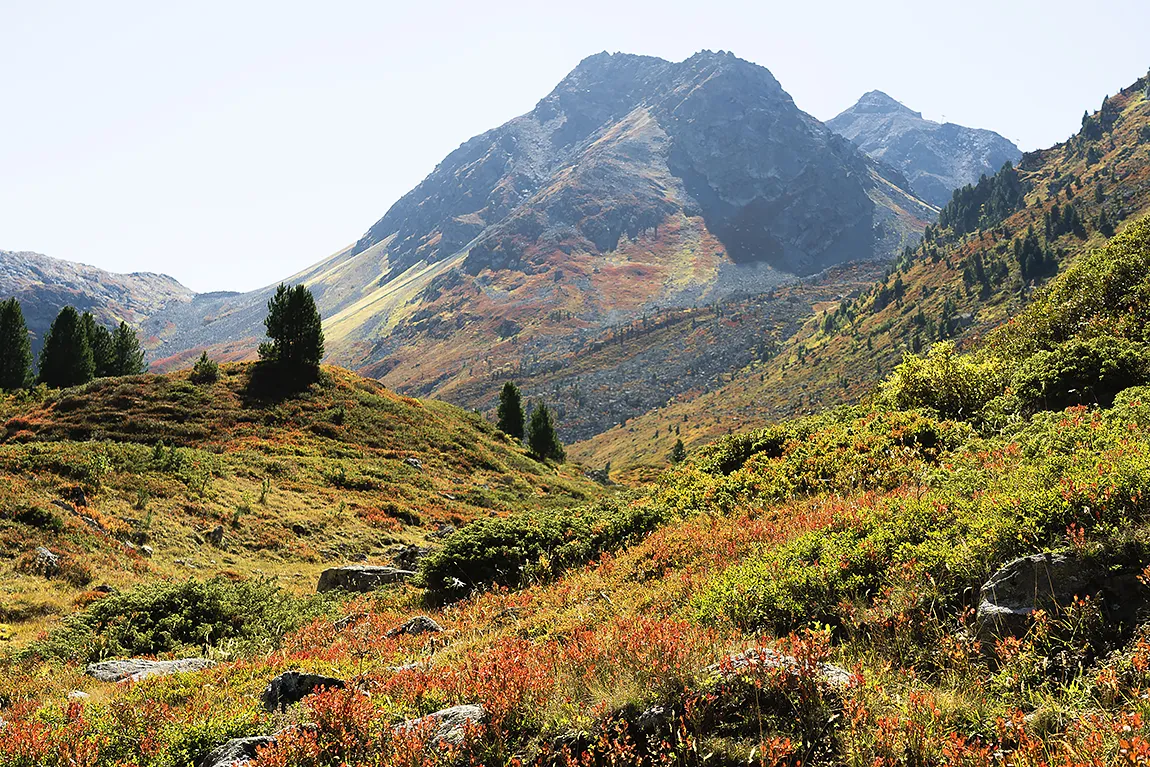


With a photography assignment for autumn photos, I (too) often think of wooded mountains with yellow leaves and some perfect leading lines. In the flat Netherlands, mind you, there are no mountains. Unfortunately, I also live in a part of the Netherlands known for its many flower bulb fields. Probably this part is also the largest virtually contiguous bulb field in the world. That’s because this area consists almost entirely of former seabed, the clay of which is very suitable for this form of agriculture. For one month of the year (April–May), I see all the colors of the rainbow in the fields around me. For the rest of the year, my ability to take interesting landscape photographs is put to the test. In this area, sweeping landscapes are dominated by monochrome fields (brown-grey), framed by the straight lines of ditches and rows of trees. Over the last decade, they have also been dominated by the many wind turbines that dot the horizon here. As soon as the trees begin to change color, the sea breeze sweeps across the open fields and, within a few days, the bare branches are no longer worth photographing in autumn. For me, this is often a reason to travel to other parts of the Netherlands in autumn, where I can still reasonably expect to find the autumn scene I’m looking for. Most of my autumn photos certainly don’t come from my own province. This time, however, I wanted to change that.
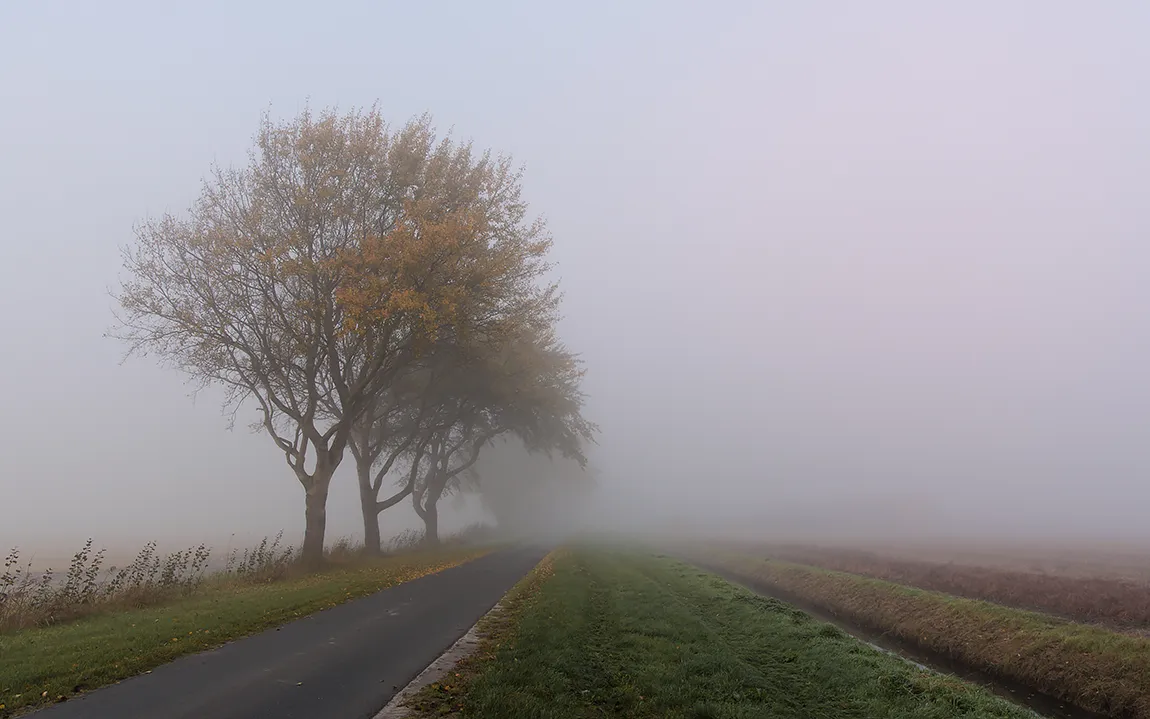
Of course, there are lovely spots near where I live, and those open, flat polders do have a certain charm of their own, not least because they allow me to recognize the Dutch landscape straight away. With autumn photos in mind, I’ve been heading out regularly lately to photograph how the polder looks in autumn. When this assignment from LPM came through, an interesting weather forecast was also released. It doesn’t happen often in my part of the country, but the following morning there was set to be thick fog here too. I put on my coat and got in the car. And although I thought I knew the area quite well, I was still glad I had the car’s sat-nav. The countryside really does change quite a bit when you’re driving through thick fog. That morning, I let myself be surprised by what I came across: a few cows in a seemingly empty meadow, a cyclist on a straight polder road, and a bulb field where the bulbs had just been planted and the farmer was busy spreading straw over them for the winter. Yellow straw, a blue tractor, and nothing but fog. It was all rather nice, but it didn’t quite give me an autumnal scene (unless you know when the farmers plant and cover their bulbs). At one point, I drove under a row of trees with a few remaining autumn leaves. As I reversed to find the right angle for a potential photo, I was glad not to encounter any other traffic here. But this is ultimately the image of autumn in the polder that I had in mind. You can clearly see where the prevailing wind is coming from. The polder with its straight lines is easily recognizable, and the ‘ugly’ wind turbines are hidden by the mist. Personally, I don’t think it’s a spectacular autumn photo, nor does it live up to my ideal image of how I like to see autumn in other photos. But this is where I live – perfectly normal to me, yet perhaps special to others.