

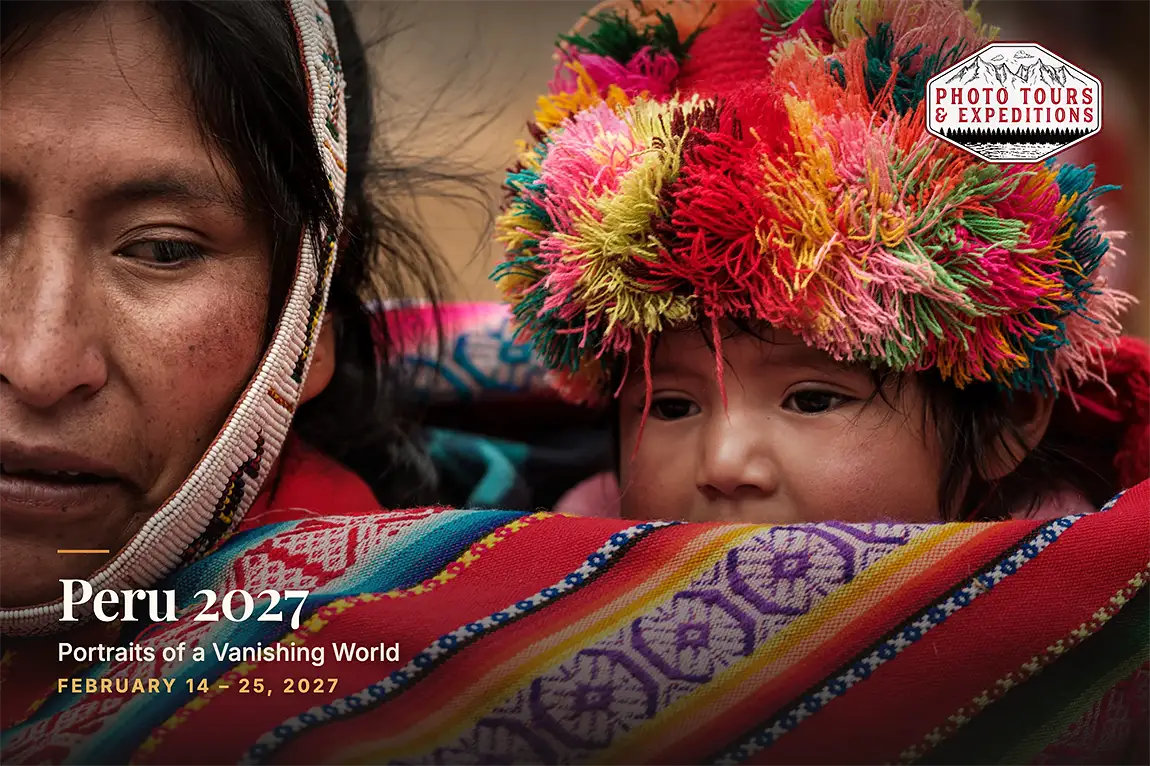
The hardest thing to find in travel photography is genuine access. Showing up with a camera is easy. Being somewhere long enough, and trusted enough, that people go about their lives in front of you takes relationships. Our Cusco-based guide has spent years building them in Willoq and Q’eros. He speaks Quechua. He knows the families by name. When we arrive, the introduction is warm, and the doors open. That is not something you can book through a standard tour operator.
In Q’eros, we sleep inside the homes of the families who host us. Tents on earthen floors, out of the wind, no hotel, no tourist infrastructure, no other groups alongside you. The four nights there involve no running water, no showers, and a portable toilet. We are straightforward about that because the photographers who are right for this trip already understand it is part of what makes the access real.
The structure of the expedition reflects how these three places actually work photographically.
Willoq is intimate and accessible, a strong entry point that calibrates your eye for portrait work in the Sacred Valley light. Q’eros is the center of gravity of the whole trip: four days in the high highlands, sleeping in the villages, working at real altitude. Lake Titicaca is the landing, a change of scale and palette after the intensity of Q’eros, with the water and the reed islands giving the portfolio a completely different register to close on.
Eight participants maximum. That number is a photography decision. A smaller group moves more naturally through a village. Families stay relaxed. Everyone has room to work without stepping on each other.
Daniel leads as photographer and tour leader. Our local guide, also a photographer, runs all ground logistics in Peru. Between them, the operational complexity disappears, and you can focus on making photographs.