

Chugach National Forest is the second-largest forest in the United States. At 6.9 million acres (27,958 km2), it covers parts of Prince William Sound, the Copper River Delta, and the Kenai Peninsula in Southcentral Alaska. While much of the terrain it encompasses is mountainous with many tidewater glaciers, the forest is the northernmost temperate rainforest in the Pacific temperate rainforest region. Despite its subarctic latitude, and occupying a narrow strip between icy alpine zones and the ocean, the forest is quite lush and dense. It is home to numerous birds, mammals, and marine animals, including bears, eagles, and all five species of Pacific salmon.
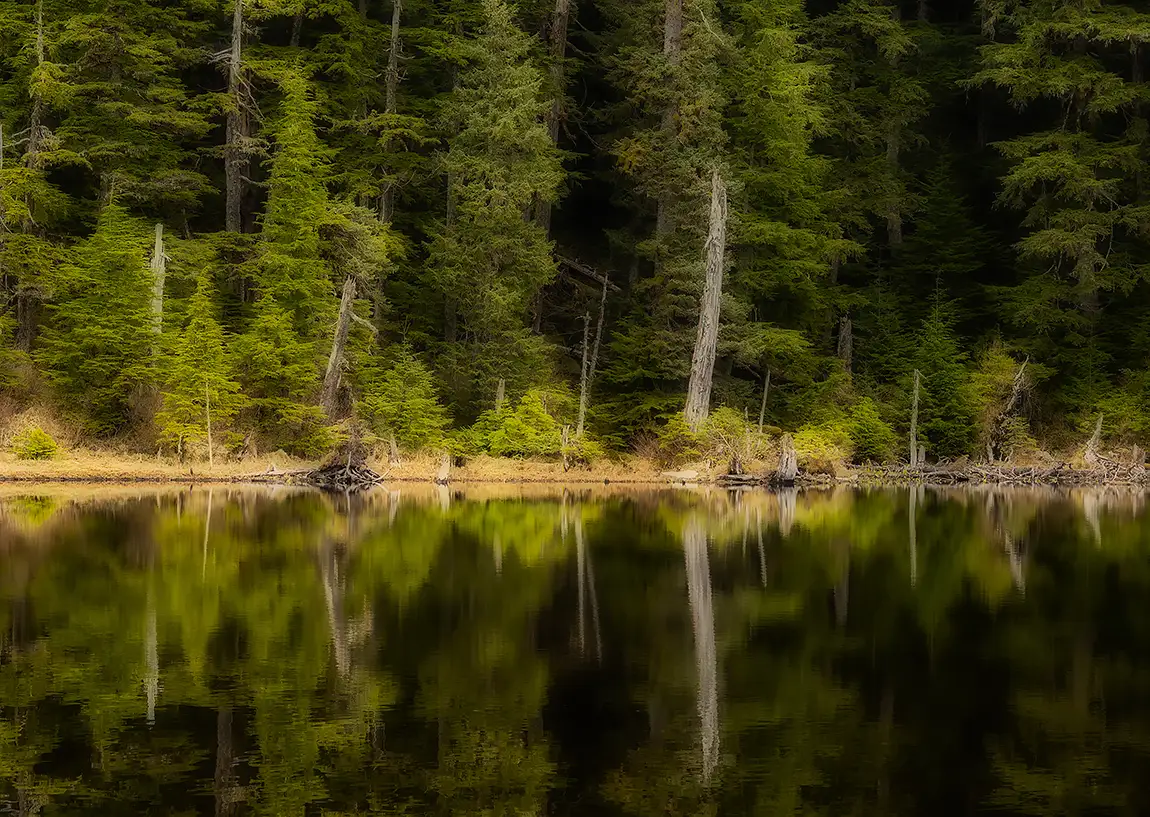
While on a trip to photograph the spring bird migration in the Copper River Delta, I passed by a pond that had just melted out from the winter. The weather was overcast and calm with a nice reflection of the forest at the pond’s edge. Nourished by plentiful moisture, the mix of spruce and hemlock trees and undergrowth looked impenetrable. Even light does not reach far into the forest, and the darkness lent a primeval eeriness to the scene.
To emphasize this, I processed the photo using the Orton Effect. Named after Canadian photographer, Michael Orton, the technique basically works by combining two exposures, one completely in focus and the other out of focus, either in-camera or in post-processing. The resulting Orton composite has a dreamlike, ethereal glow. In this photo, the trees closest to the pond pop with a halo of soft light, contrasting with the interior trees as they recede into the dark background. Did I achieve my artistic goal? How far would you venture into this mysterious forest?