

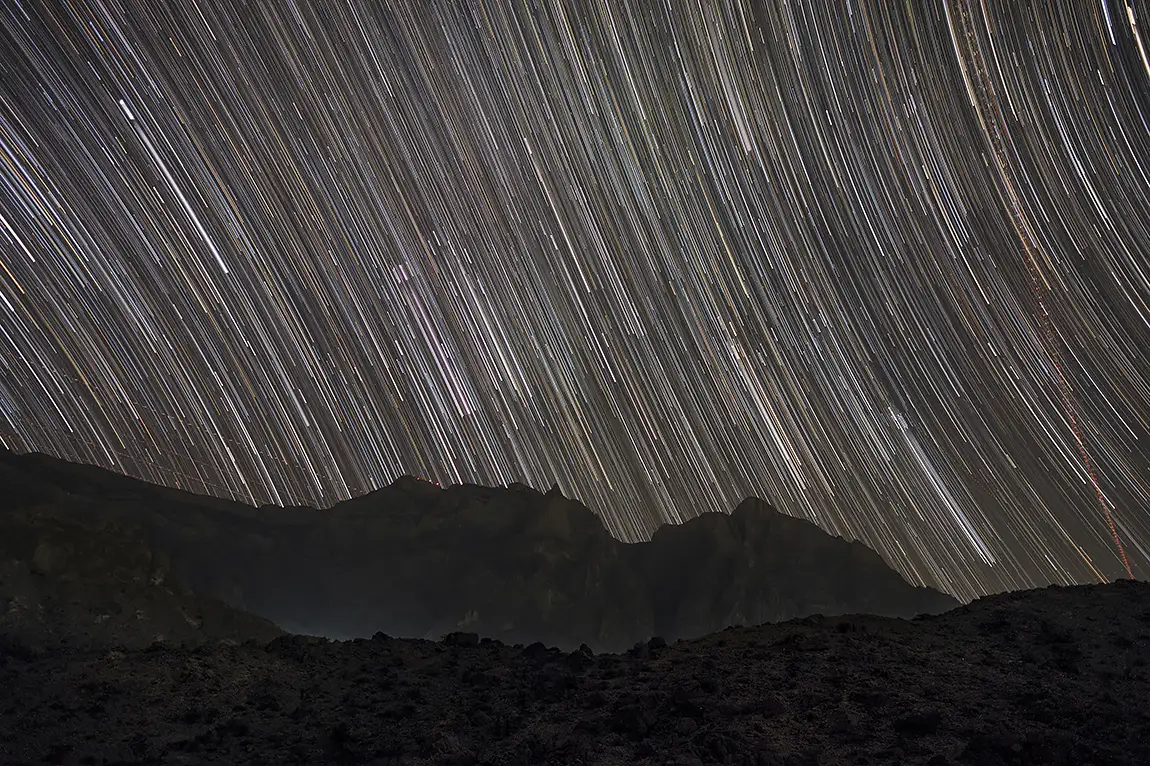
I am part of a local astronomy group that regularly goes on weekend trips to dark sites, normally around the new moon period. Here in Oman, there are still a few locations that are remote enough to allow good observation, where light pollution is lower than usual.
Other participants have much more complex equipment than me, with telescopes and special imaging cameras. I only bring my camera and wide-angle lens and plan to shoot the night sky, either for the Milky Way or star trails. The former is still not visible in the wintertime, so on this last trip my goal was to do a star trail.
The location was inside Wadi Sahtan, at the foot of the impressive north face of Jebel Shams, the highest mountain in Oman. After setting up camp, the group proceeded to assemble the telescopes in preparation for the night’s observation. After sunset, the temperature dropped rapidly; after all, this was still mid-February.
I wanted to make a star trail with Jebel Shams in the frame; this meant pointing the lens to the northwest, missing the celestial north pole. We have all seen those nice star trails where they revolve around Polaris, and I have made my fair share of those.
Positioning my camera and lens on the tripod, I made a few test shots. Normally, I shoot in RAW format, with exposure settings of 30 seconds, f/2.8, and ISO 1600. Happy with the composition, I used the camera’s intervalometer to shoot 200 exposures, giving a total time of 100 minutes.
Later, I assembled the star trail in Sequator. I was happy with the result; it is almost like a rainfall of stars descending over the mountain.