

Some landscapes reveal themselves at once. Others ask for time. Not because they are more complex, but because they are built from only a few elements: a hill, a field of ripe wheat, and a sky in constant motion. Nothing demands attention. Nothing needs to explain itself.
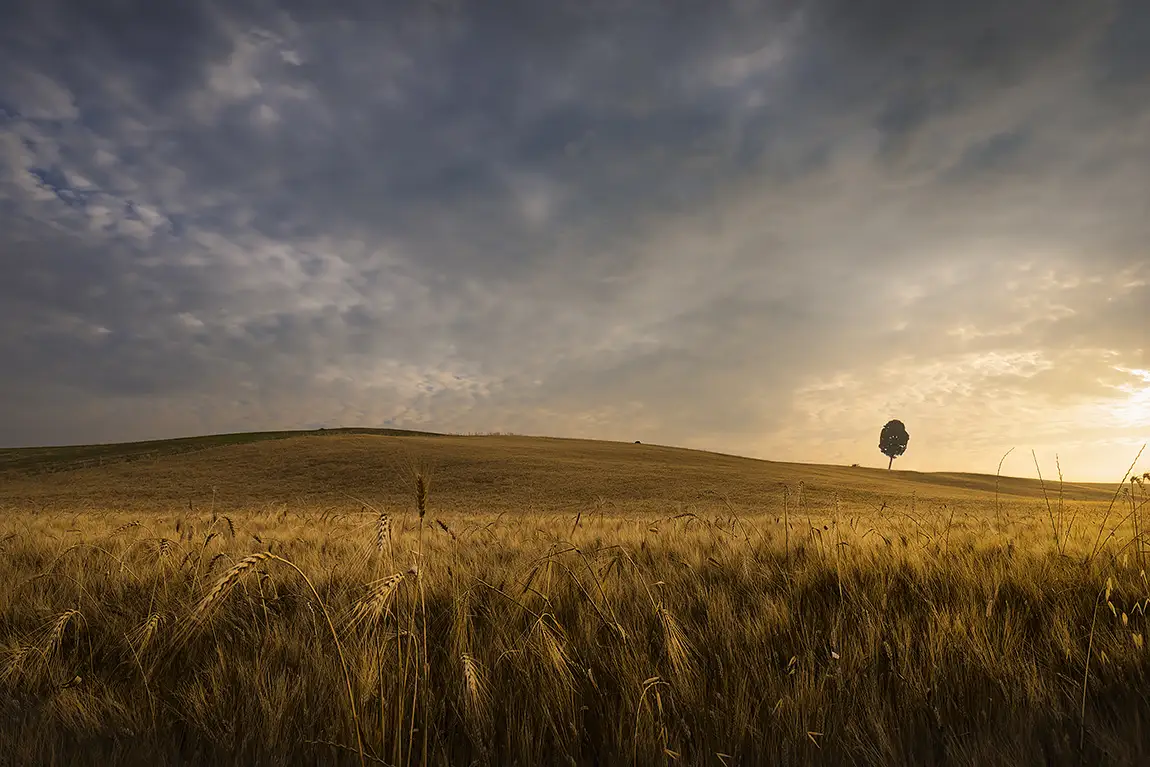
That morning, the day arrived without haste. Clouds covered most of the sky, allowing the sun to filter gently through their thinner layers. There was no dramatic light to chase. Instead, the countryside gradually emerged from the shadows, revealing the golden wheat, the gentle rise of the hill, and a solitary tree standing on the horizon.
As I walked along the edge of the field, I watched the wind sweep through the wheat. Every gust changed the landscape; not in its shape, but in its breathing. Golden waves travelled across the field like an invisible current. For a few moments everything settled, only for the next breeze to transform the scene again.
My eyes kept returning to the tree. It was neither large nor dominant, yet in such an open landscape it carried an unexpected presence. Perhaps every element gains greater significance when there are so few of them. Perhaps the tree seemed to guard something I could not define. Or perhaps it simply represented permanence. While the wheat bent beneath the wind and the clouds continually reshaped the light, the tree remained. Not motionless, but quietly present.
As I stood there, I realised I was not searching for a subject. I was searching for balance. How little is truly needed for a landscape to speak? How many elements are required to create emotion? We often assume that the strength of a photograph lies in complexity, yet the opposite is frequently true. The more a landscape is reduced to its essentials, the more clearly its character begins to emerge.
Looking at the photograph now, I do not believe the subject was solitude. Solitude suggests absence, yet the tree appears to lack nothing. It exists exactly where it is meant to be. It does not seem abandoned. It feels necessary. Perhaps that is what I continue to search for when I photograph landscapes like this: not extraordinary places, but quiet presences that give meaning to the space around them. Elements that never demand attention, yet gradually become the silent centre of everything unfolding around them.
As the morning light slowly strengthened, the wheat began to glow and the contours of the hill became more clearly defined. The tree remained exactly as it had been all along: small, distant, and unhurried. It seemed to belong so completely to that place that the changing light and passing wind became little more than the rhythm of its surroundings. Perhaps that was why I could never stop looking at it.