

One of the greatest joys of landscape photography is discovering that the most compelling subjects are often hiding in plain sight.
When most people think of Hawaiʻi’s Big Island, they picture crashing surf, palm-lined beaches, or glowing lava flowing into the sea. Those scenes deserve their reputation, but over the years I’ve found myself increasingly drawn to something quieter—places where the ocean reveals its character in unexpected ways.
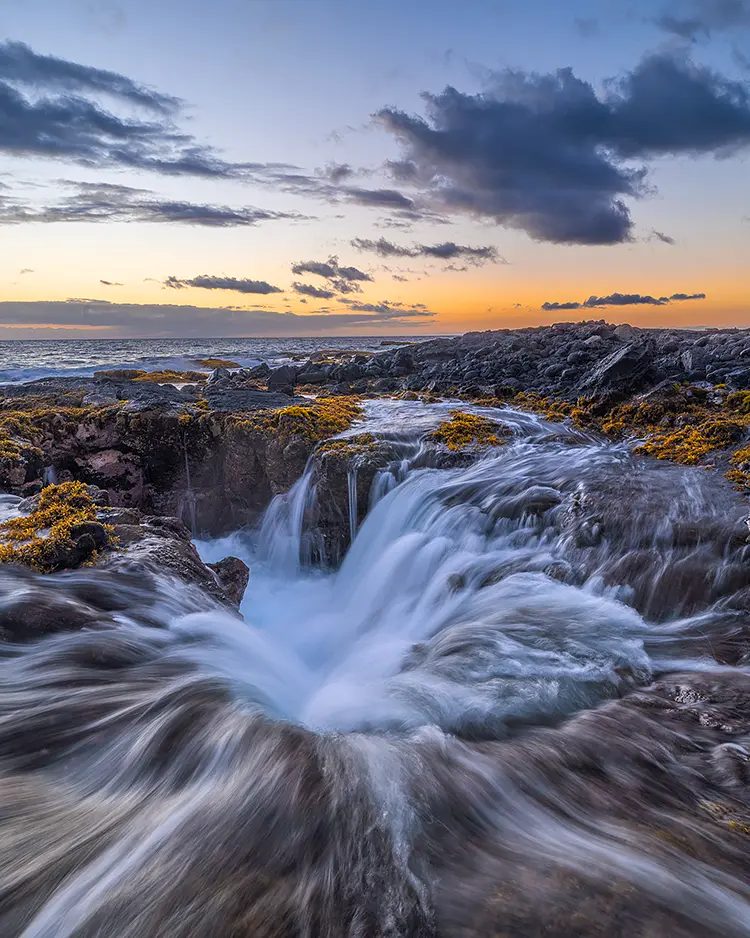
This photograph was made along a stretch of volcanic shoreline where the Pacific disappears beneath ancient lava before reappearing moments later. At first glance, there is little to suggest anything unusual. Black lava stretches toward the horizon while waves roll in from offshore. Yet beneath the surface lies an intricate network of lava tubes and fissures created during countless eruptions over thousands of years.
As each wave arrives, seawater is forced through those hidden passages. Pressure builds beneath the rock until the ocean quietly rises through an opening in the lava. For only a brief moment, the water seems suspended above the shoreline before gravity reclaims it, sending it back into the underground channels to begin the process again.
Watching this cycle repeat became mesmerizing. Unlike photographing a breaking wave, there was no obvious peak moment. Every surge was different. Some barely disturbed the surface, while others created elegant ribbons of water that twisted and folded back into the volcanic basin. Success depended less on anticipation than on patience—studying the rhythm of the ocean until I began to recognize the subtle variations that transformed an interesting scene into a compelling photograph.
What struck me most wasn’t the power of the Pacific but its restraint. Here, the ocean wasn’t crashing against the shoreline. It was breathing through it. The volcanic rock, born in unimaginable heat, now serves as a conduit for the sea. Fire created the landscape, while water continues the slow work of shaping it. Standing there, it became impossible to think of the island as static. Every wave reminded me that Hawaiʻi is still alive, still evolving, still being sculpted by forces both visible and hidden.
That realization changed the way I looked at the coastline. Instead of searching for dramatic waves, I began searching for evidence of movement beneath the surface—for places where the landscape quietly revealed the processes that continue to define these islands. It reinforced something I’ve come to believe after decades behind a camera: remarkable photographs often begin not by finding extraordinary places, but by learning to observe ordinary places more deeply.
Landscape photography has taught me that slowing down is often more valuable than moving on. The longer I remained beside this lava shelf, the more I noticed—the cadence of the swells, the changing reflections, the subtle differences in each surge, and the quiet conversation between water and stone that has been unfolding there for centuries.
This image is a reminder that nature doesn’t always announce its wonders with grand spectacle. Sometimes it whispers.
If we’re willing to wait, to watch, and to truly see, the landscape has remarkable stories to tell.