

Washington’s North Cascades National Park has been carved by glaciers into dramatic 1,600 m deep U-shaped valleys, razor-sharp ridges, and steep slopes where glaciers still cling despite warming temperatures. One of my favorite spots here is Hannegan Peak on the park’s northwest edge. The hike to the summit is just 8 kilometers, but the last 0.8 kilometers have a challenging 300 m elevation gain—especially with a fully loaded backpack. Still, reaching the top is worth the effort. My aim was to camp near the summit, catching both sunrise and sunset views.
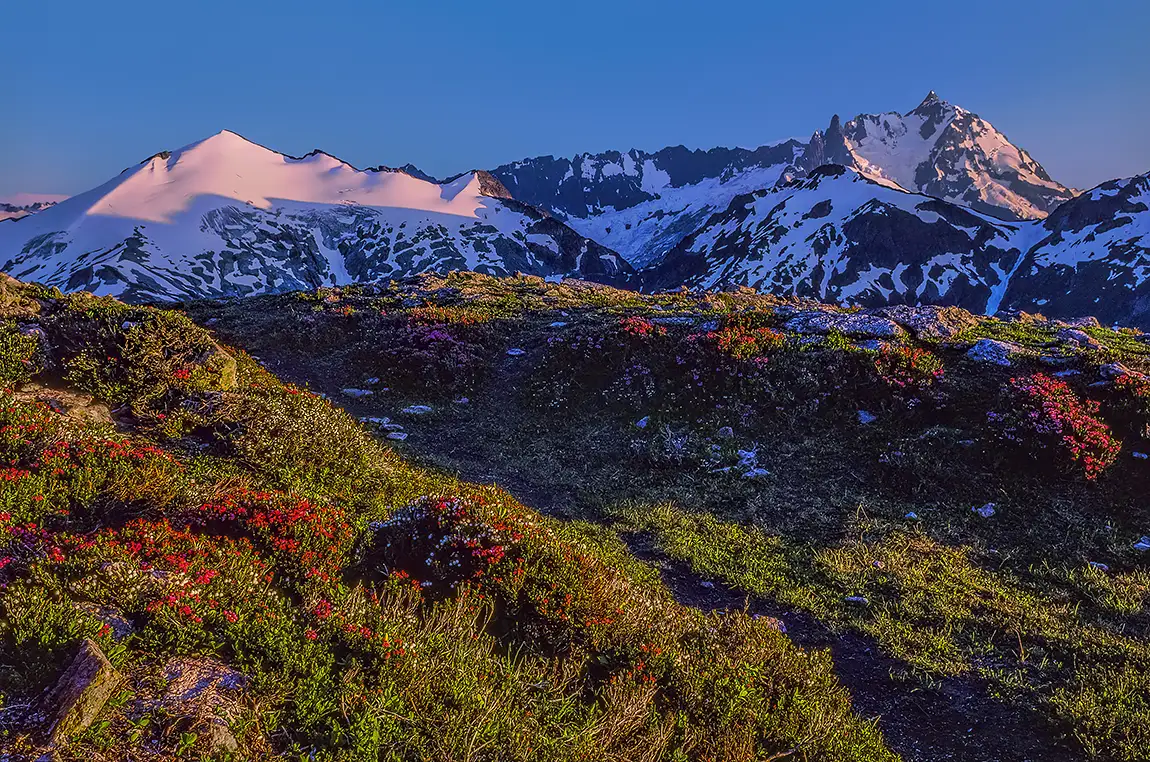
From this vantage point, many iconic North Cascades peaks can be seen, but none stand out like Mt. Shuksan to the south. Its allure comes from a sheer north wall, jagged ridge lines capped by a summit horn, and glaciers hanging on impossibly steep slopes. This region boasts a world record for seasonal snowfall—nearly 30 meters—which nourishes the local glaciers. In front of the mountain is Nooksack Ridge, impressive in its own right, which helps to frame the mountain. The top of Hannegan Peak is a broad dome covered with beautiful, flower-filled meadows.
To capture the essence of this place, I wanted an image that balanced the rugged mountain horizon with the gentle, flower-strewn meadows in the foreground, inviting viewers to imagine themselves there. The sunset lighting added drama to the scene, contrasting the dark, shadowed ridges with the glacial ice and the warmly lit foreground. The deep shadows caused by the low sun angle traced through the meadows, guiding the eye toward the mountains.
Achieving the desired depth of field required a wide-angle lens at a small aperture. Slow Kodachrome film kept grain to a minimum and ensured crisp detail, though it required a slower shutter speed, making a tripod indispensable. The final image was produced by scanning the original slide with a Canon EOS R6 Mark II and refining the digital file in Photoshop.